Saint Torque’s Second Letter: On Hills, Humility, and High Amps
Opening Scripture
From Saint Torque’s Second Letter to the Wheelievers of the Steep Places, Chapter 1, Verses 1–10
Torque, a servant of the Wheel and witness unto many avoidable climbs, unto the wheelievers who dwell among grades, driveways, and overconfidence: grace be unto you.
I write not because ye know not the hill, but because ye keep acting surprised by it.
For every rise in the earth testeth both battery and spirit.
The humble rider readeth the slope from afar and prepareth his stance.
But the proud rider seeth the incline and saith, “Surely today physics shall make an exception for me.”
Children, let no man deceive you with edited videos of effortless ascent.
For many climbs are filmed at 72% battery and posted as testimony at night.
Blessed is he who checketh his PSI before speaking boldly of hills.
And blessed still is he who heedeth pushback before the pavement composeth a rebuttal.
For high amps reveal what low character concealeth.
I. Saint Torque Writes Again, Because Apparently the First Letter Was Ignored
Wheelievers, we turn now to the second letter of Saint Torque, patron of steep neighborhoods, smoked thighs, and lessons learned one driveway too late.
His first letter warned against arrogance on flat ground. It spoke plainly of speed, of stance, of men who treat the app like a prophecy machine and then act wounded when numbers become consequences. But now Saint Torque addresseth a deeper sickness in the congregation: hill confidence.
There are riders who are normal on level pavement. Thoughtful. Teachable. Even pleasant. Yet let the road tilt upward by six degrees and suddenly they become motivational speakers. They start saying things like, “This is where torque shines,” while their board is at 24%, their headlamp is on for no reason, and their soul is halfway out of alignment.
The hill doth this to people. It awakens a false nobility. It persuadeth a man that struggle is automatically glorious, when in truth some struggle is merely poor planning in wrist guards.
For not every incline is a calling. Some are simply a warning with landscaping around it.
II. On Hills, Which Are the Lord’s Way of Asking if You Meant It
The flat path flattereth. It leteth a rider believe he understandeth himself. It tolerateth sloppy form. It forgiveth weak ankles. It lets a man post a smooth carve and go home thinking he has been chosen.
But the hill asketh questions.
The hill asketh whether thy battery is truly where thy app claimed it was. The hill asketh whether thy PSI is righteous or whether thou hast been postponing maintenance in the name of “vibes.” The hill asketh whether thy stance is centered over the footpad or whether thou art just leaning into chaos with a confident face.
And above all, the hill asketh whether thou camest to ride, or to perform.
For many riders approach the incline not to conquer terrain but to impress witnesses. They yearn to ascend in front of dog walkers, brunch-goers, and random men in parking lots who do not care and never asked. They dream of being the one who glideth uphill with calm majesty while lesser mortals stare from below and reconsider their transportation choices.
Instead they meet pushback.
And pushback, wheelievers, is not an insult. It is a stern elder placing one hand upon thy shoulder and saying, “Enough theater. Adjust thy expectations.”
Blessed are those who feel pushback and repent immediately. Blessed are those who turn slightly, descend with dignity, and seek a flatter route without making it into a personality. For theirs is the kingdom of getting home with both knees still emotionally available.
III. The Parable of Brother Eli and the Cul-de-Sac of Testing
Hear now the parable of Brother Eli, who was beloved among the wheelievers because he owned excellent pads, spoke often of “clean lines,” and confused optimism with preparation.
Now Eli lived in a neighborhood built by developers who clearly hated calves. Every street rose. Every side road angled upward. Even the mailboxes seemed to judge from higher ground. And Eli had long told the congregation, “My board loves hills.”
This was not true. His board tolerated hills the way a patient grandfather tolerates loud children with sticky hands.
One evening, after a group ride rich in boasting and poor in charger discipline, Eli turned into the steepest part of his subdivision. The sun was low. The battery was lower. Yet because there were witnesses behind him, he did not dismount. He did not reroute. He did not ask the sacred question, “Is this wise?” He simply leaned forward with the confidence of a man whose YouTube history had misled him.
At first the board climbed.
And Eli thought within himself, “Behold. Saint Torque smileth upon me.”
But halfway up the hill came battery sag, swift and invisible as a tax notice. Then came pushback, which Eli interpreted not as mercy but as a challenge. So he leaned harder.
This, beloved, was the moment heaven covered its face.
The board slowed. Eli persisted. The sensor remained engaged, but his judgment disengaged completely. And though he did not nosedive in the full and cinematic manner of the boastful, he did step off into a panicked uphill jog that made him look like he was trying to arrest his own vehicle.
When at last he reached the top, out of breath and stripped of illusion, the group arrived beside him in silence. One sister in the congregation merely said, “High amps, huh?”
And Eli replied, “I think the firmware’s been weird on climbs.”
Thus was the ancient prophecy fulfilled: man will blame software before admitting he tried to summit a cul-de-sac with 18% battery and a crowd behind him.
IV. On Humility, Which Is Faster Than Walking a Dead Board Home
Let Saint Torque say this plainly: humility is not weakness. Humility is knowing when to stop pretending.
Humility is taking the gentler line. Humility is recognizing that regen braking on the way home is better than a heroic story that endeth with carrying thy board past a group of children eating popsicles. Humility is accepting that there are days for hill repeats and days for flat loops and days when the charger was forgotten and the spirit must live accordingly.
Yet our age hateth humility. The algorithm rewardeth spectacle. The comments adore foolishness packaged as mastery. Men with action cameras climb improbable grades and then speak into the lens as though they have discovered moral truth, when in fact they have merely discovered editing.
Meanwhile the truly wise rider turneth off the camera, checks the route, lowers the speed, and surviveth with boring excellence.
Do not despise boring excellence, wheelievers. It filleth the land with unbroken collarbones.
Leader: What testeth the soul?
Wheelievers: THE HILL TESTETH THE SOUL.
Leader: And what revealeth the proud?
Wheelievers: HIGH AMPS REVEAL THE PROUD.
Leader: And what is holier than forcing the climb?
Wheelievers: MAKING IT HOME WITH DIGNITY.
V. Saint Torque’s Counsel on High Amps and Other Intimate Judgments
Now some of you hear “high amps” and become intoxicated with technical speech. You start posting graphs. You start saying “power delivery” in a voice that suggests both expertise and recent embarrassment. You start acting like the board is a dragon and ye are medieval electrical theologians.
Calm yourselves.
High amps are real, yes. Hills demand. Torque answereth. Batteries strain. Systems consider thee and make certain choices. But for many riders, technical knowledge becomes just another robe for pride. They learn three phrases and immediately begin climbing things their judgment has no business touching.
Remember this: knowledge without humility is just ego with a charger.
The board careth not how many forum threads thou hast read. It careth not how many times thou hast typed “bro it can handle way more than people think.” The Wheel knoweth only weight, angle, battery, surface, stance, and whether today you have confused curiosity with divine appointment.
That is why the footpad sensor remaineth such a holy mystery. It detecteth presence, yes—but the hill detecteth character.
VI. The Weekly Rite of the Righteous Detour
Therefore I give unto you this week’s sacred practice: The Rite of the Righteous Detour.
When next thou approachest a steep incline, pause before it as one pause before a text that could ruin an evening.
Look upon the hill. Look upon thy battery. Look again upon the hill, for some of you are liars to yourselves on the first glance.
Then ask aloud these four questions:
“Is my battery sufficient?”
“Is my PSI honest?”
“Is this line wise?”
“Am I doing this because it is necessary, or because Kevin is watching?”
If the answer to the last question troubleth thee, choose another route immediately.
Then perform one slow ceremonial ascent on a modest grade. Not the steepest. Not the one you brag about. The modest one. Keep thy shoulders quiet. Keep thy knees soft. Let thy carve disappear. This is not the hour for flourish. This is the hour for reverence.
And if during the climb thou feelest pushback, honor it. Do not argue. Do not negotiate. Do not try to squeeze glory from a system that hath already sent word.
For the board’s first warning is gentle. Its second warning is public.
VII. Final Exhortation from the Saint of Steep Places
So let Saint Torque’s second letter dwell richly among you.
Read it when the road tilts. Read it when the battery droops. Read it when a friend says, “You’ve got this easy,” which is among the least trustworthy phrases in the riding life.
Be not seduced by men who climb hills like prophets and descend like cautionary tales. Be not impressed by top-speed screenshots taken moments before a very quiet walk home. Be not fooled by thy own previous success, for many have mistaken “it worked yesterday” for covenant.
The hill is patient. The hill will wait. The hill is not going anywhere. Thy dignity, however, is mobile and easily lost.
Therefore ride with discernment. Let thy headlamp serve darkness rather than vanity. Let thy battery percentage inform thy courage. Let thy firmware remain blameless until thou hast first interrogated thy own decisions. And when the steep road calleth unto thee, answer not always with force, but sometimes with wisdom and a dignified left turn.
Closing Words
From The Epistle of Saint Torque, Chapter 2, Verses 11–15
Children, climb not every hill that flattereth thy ego.
For some ascents are lessons, and some are merely traps with curb appeal.
Honor the warning, respect the amps, and keep thy humility above thy confidence.
Blessed is the rider who descendeth in wisdom rather than ascendeth in foolishness.
And may thy battery be strong, thy route be sensible, and thy uphill testimony require no witnesses.
Did this sermon spare thee from walking?
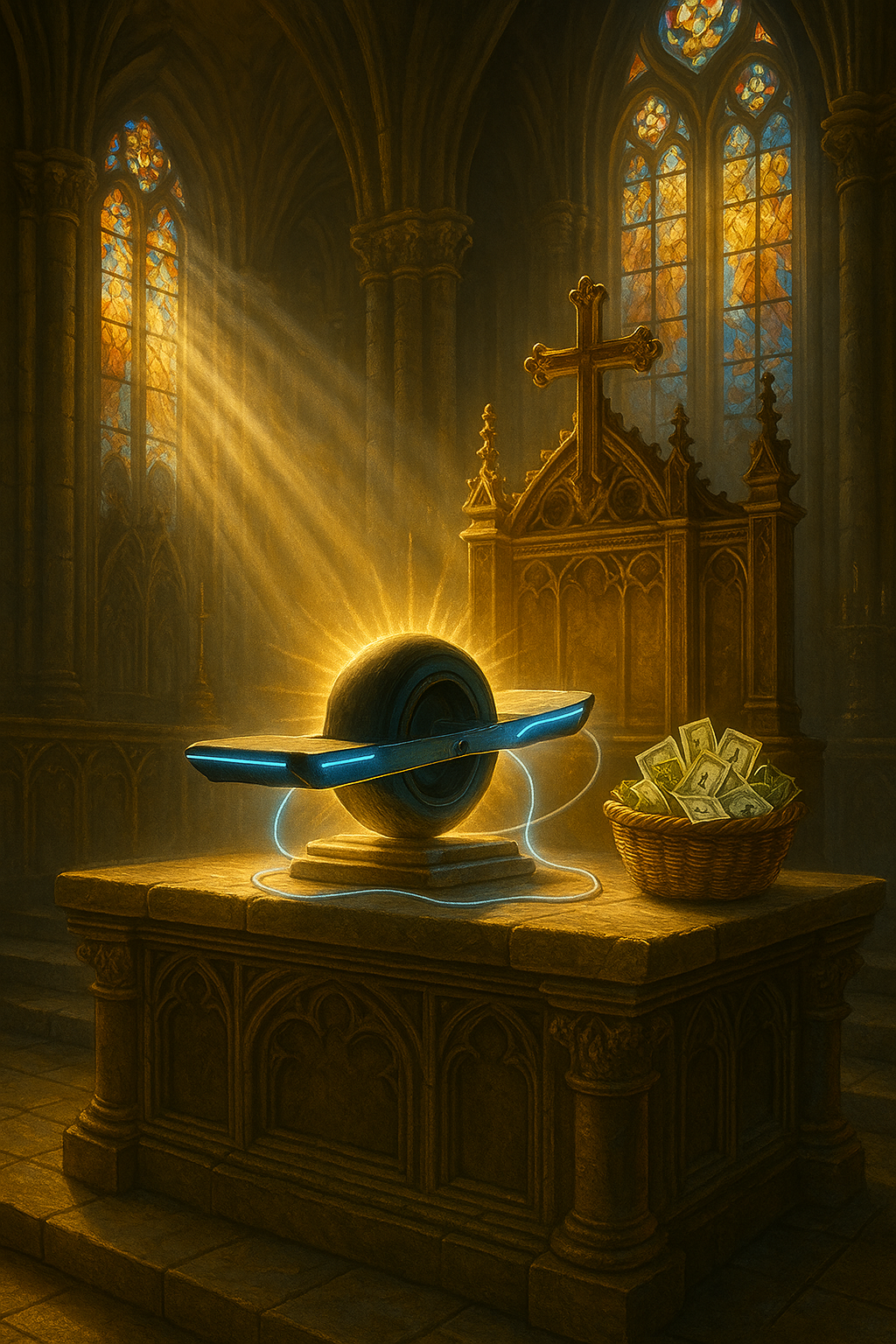
Toss $5 into the offering plate to keep the sermons flowing, the wheel turning, and the Prophet only moderately overconfident.
Bless the Wheel — $5No pressure. No indulgences sold. Just sacred nonsense, lovingly maintained.
Continue the Pilgrimage
The Wheel has more wisdom to reveal. Read another sermon before returning to the cursed world of walking.