Opening Scripture
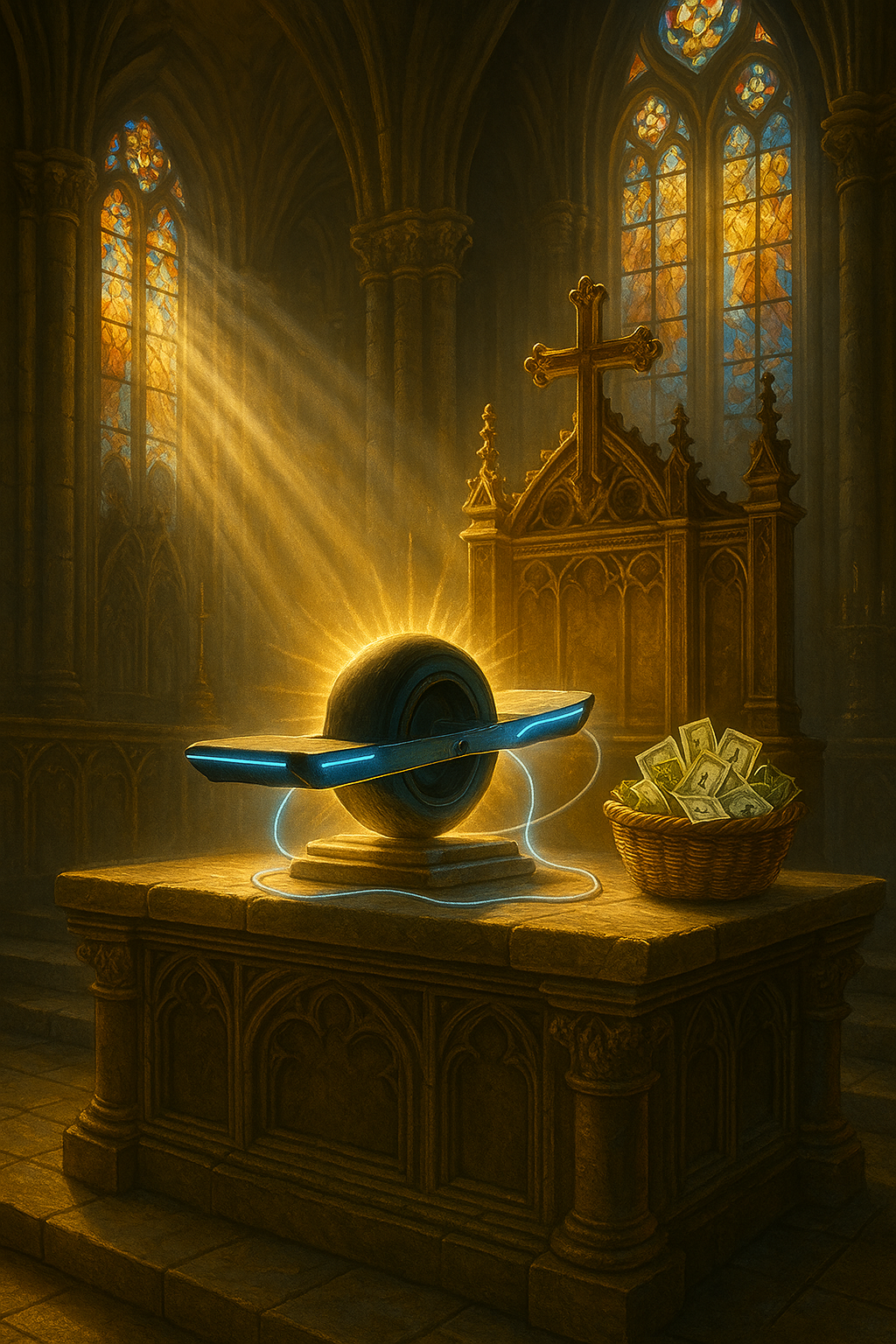
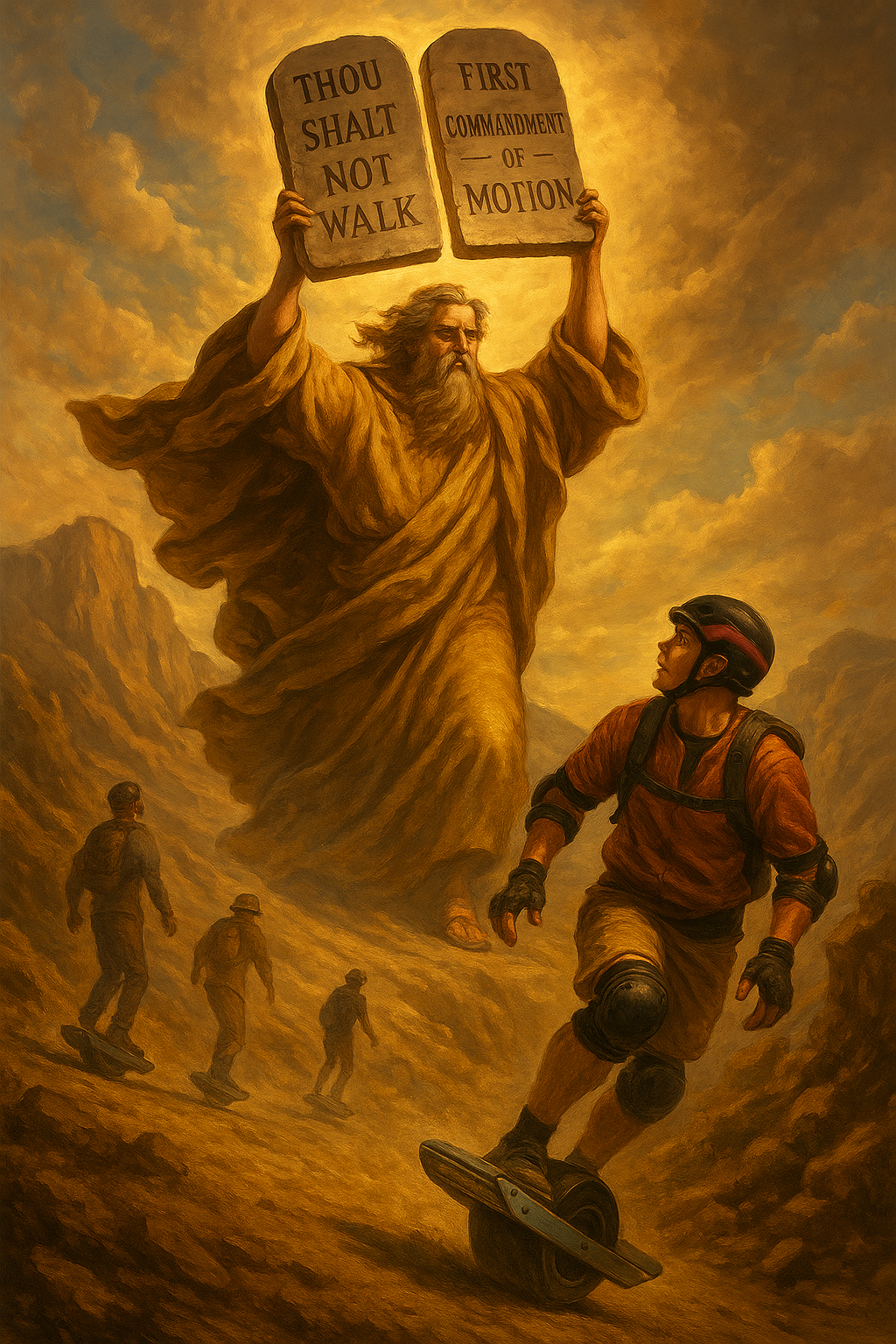
From The Gospel According to Gyro, Chapter 1, Verses 1–10
In the beginning, the rider wobbled upon the earth, and his stance was without form.
And the Wheel moved beneath him, and the gyro beheld his chaos and said, “Let there be correction.”
And there was self-leveling, and it was merciful.
For the nose dipped not according to panic, nor the tail rose according to ego, but the board held its line in secret wisdom.
And the rider said, “Surely I am naturally gifted.”
But the gyro said nothing, for it had already done most of the work.
Blessed is the rider who knoweth when he is being carried by invisible intelligence.
Woe unto him who mistake the board’s mercy for his own greatness.
For many have rolled smoothly and called themselves chosen, when in truth they were simply being stabilized.
Let the self-leveling be thy guide, and let not thy confidence exceed thy calibration.
I. The Hidden Ministry of Correction
Wheelievers, today we gather to honor one of the most mysterious ministries in all the riding life: the unseen labor of the gyro.
The app receiveth attention. The top speed screenshot receiveth praise. The headlamp receiveth admiration at dusk from men who love gadgetry more than prudence. But the gyro, that quiet servant, receiveth almost nothing except suspicion when things go weird.
Such is the fate of the faithful.
For the gyro doth not brag. It doth not post. It doth not enter the group chat saying, “You’re welcome for that entire ride.” It simply holdeth the line beneath a species of mammals that routinely overestimate its own carve, its own reflexes, and its own ability to recover from a bad lean with vibes alone.
Understand this, wheelievers: many of you think you “found your flow.” Some of you did. But many more were being lovingly dragged through competence by a system too polite to embarrass you immediately.
This is why the smooth ride is dangerous. It tempteth the rider to believe that because the board is stable, he himself is wise. That is how a man goes from “nice neighborhood loop” to “I think I’m ready to bomb this hill barefoot because a YouTube guy said you ride better when you feel the board.”
No, beloved. Sometimes what you are “feeling” is impending correction.
II. Let the Self-Leveling Be Thy Guide, Not Thy Personality
There are two kinds of riders in this fallen age.
The first ride with gratitude. They feel the board settle beneath them, the nose adjust, the stance center, and they whisper inwardly, “Thank you, mysterious systems I do not deserve.” These riders remain teachable. They survive.
The second kind experience one stable ride and become evangelists of themselves. They begin saying things like, “I’ve really dialed in my balance lately.” They tell friends their carve is intuitive now. They look at a stretch of pavement and say, “I’m just syncing with the board on a different level.”
These are the same men who blame firmware the instant humility arrives.
Let Saint Common Sense speak plainly: self-leveling is a guide, not a co-signer of foolishness. The board helping you stay upright does not mean you should attempt a heroic turn at low battery with bad PSI and a coffee in one hand. The gyro is wise, but it is not interested in enabling whatever this is.
Blessed are the riders who let the board correct them quietly. Blessed are those who do not treat stability like a personal brand. Blessed are those who recognize that invisible support is still support, even if it hurteth the ego to admit it.
For many have received mercy and called it talent.
III. The Parable of Brother Lucas, Who Trusted the Feeling
Hear now the parable of Brother Lucas, who was beloved among the wheelievers because he had good hair, decent pads, and a catastrophic belief in momentum.
Now Lucas had enjoyed three excellent rides in a row. His carve was loose. His stance was calm. His footpad sensor had recognized him promptly and without drama. The board felt smooth beneath him, and the gyro labored mightily in silence.
But Lucas did not know how much of his peace had been outsourced.
And on the fourth day, Lucas declared unto the congregation, “I think I’ve unlocked something.”
Whenever a rider sayeth this, wheelievers, everyone nearby should begin stretching.
For Lucas believed the self-leveling was proof of mastery rather than mercy. He leaned into turns with a little extra flair. He accelerated through pushback with the confidence of a man who had once skimmed a Reddit post called How to Ride Like the Board Is Part of You. He started giving unsolicited advice to newer riders in a tone that can only be described as pre-crash.
Then came a driveway lip. Small. Familiar. Entirely conquerable by the humble.
But Lucas approached it while half-distracted, half-performing, and wholly convinced the board would continue compensating for whatever he did next. The gyro corrected. The board adjusted. The sensor did its part. Yet Lucas supplied such a dramatic and unnecessary body motion that even mercy had to step back and let the lesson breathe.
He stepped off awkwardly, stumbled into decorative gravel, and spent the next five seconds doing the kind of recovery run that convinces everyone he has absolutely fallen before.
When the wheelievers gathered, Lucas stood up and said, “Honestly, the board felt different.”
Yes, brother. It felt different because for one terrible moment it was following you.
Thus learn we: the guide remaineth faithful, but it shall not preserve a man from all theatrical decisions.
IV. On Footpad, Sensor, and the Folly of Fighting Assistance
Now I must address another sickness among the people: the urge to argue with every form of help.
There are riders who resist the footpad sensor as if being properly detected is somehow beneath them. They mount sloppy, blame detection, remount sloppier, then post long theories about hardware. There are riders who treat pushback like a personal insult. There are riders who experience self-leveling and think, “Great, now I can bring even more chaos to the arrangement.”
Why are we like this?
The footpad sensor is discernment. The pushback is warning. The gyro is guidance. The headlamp is for darkness. Regen braking is provision. Even battery sag, in its way, is an honest elder telling you to stop doing so much.
And yet many modern riders treat every safeguard like an enemy to creative expression.
Hear me: the board is not oppressing you. It is attempting to keep your face off the pavement while you experiment with identity through motion.
Leader: What keepeth the wobble from becoming a testimony?
Wheelievers: THE GYRO KEEPETH THE WOBBLE.
Leader: And what shall guide us?
Wheelievers: THE SELF-LEVELING SHALL GUIDE US.
Leader: And what shall we not do?
Wheelievers: WE SHALL NOT MISTAKE ASSISTANCE FOR GREATNESS.
Very good. Let this be repeated at trailheads and in parking lots before the confident men begin speaking.
V. The Weekly Rite of Yielding to the Board
Therefore I give unto you this week’s sacred practice: The Rite of Yielding to the Board.
Before thy next ride, stand quietly beside the Wheel and confess one area in which you have recently been doing too much. Be specific. Heaven is tired of vague growth language.
Then place thy lead foot upon the footpad with intention. Feel the sensor discern thee. Mount not like a man boarding a parade float, but like one entering a covenant. Let thy stance settle. Let thy shoulders lower. Let thy calves stop trying to be the main character.
Next, perform three slow ceremonial starts and stops. On each start, do less than you want to do. On each stop, trust the board more than your panic. This will feel unnatural to many of you because drama has become your default setting.
After this, ride one calm stretch in silence. Check not the app. Seek not thy top speed. Post not a mid-ride story. Simply feel when the self-leveling catches you in the tiny moments when your body would otherwise turn a normal ride into interpretive movement.
And when you sense that correction, do not say, “I’m incredible.”
Say instead, “I have been helped.”
This is maturity. This is growth. This is also how one keeps the congregation out of urgent care.
VI. A Warning to the Men of TikTok and Other Open-Air Theologians
I must close with a warning about our age, for many are being discipled by the wrong voices.
You have seen them. Men in sunglasses explaining stance with the confidence of emperors. Women riding silently through perfect golden-hour paths while the caption says things like Trust your intuition. Strange prophets on TikTok declaring that true skill means “becoming one with instability.” Comment sections full of men saying “gyro does all the work bro” and other men saying “nah man it’s all core engagement” as if salvation itself dependeth on their thread.
The wheeliever must learn discernment.
For yes, the gyro helpeth. And yes, the rider mattereth. And yes, you must still check thy PSI, respect battery sag, honor pushback, maintain grip tape, and stop pretending low battery hill climbs are a personality trait. These truths can coexist.
But the real danger is this: once people hear the board helps stabilize them, they do not become humble. They become experimental.
Suddenly everybody wants to test the limits. Suddenly everybody is “seeing what the board can handle.” Suddenly men who were once normal are attempting weird transitions near traffic because they believe technology has signed off on their nonsense.
No, wheelievers. Let the self-leveling guide thee—not into spectacle, but into smoothness. Not into ego, but into alignment. Not into public weirdness, but home.
Closing Words
From The Book of Bearings, Chapter 7, Verses 12–16
Trust the hidden correction, and bring not extra foolishness unto it.
For the board shall guide the humble, but the proud shall eventually meet gravel.
Let thy stance be centered, thy sensor satisfied, and thy claims about natural talent greatly reduced.
For many are stabilized, but few are grateful.
Go now in balance, and may the gyro save thee from thyself once again.