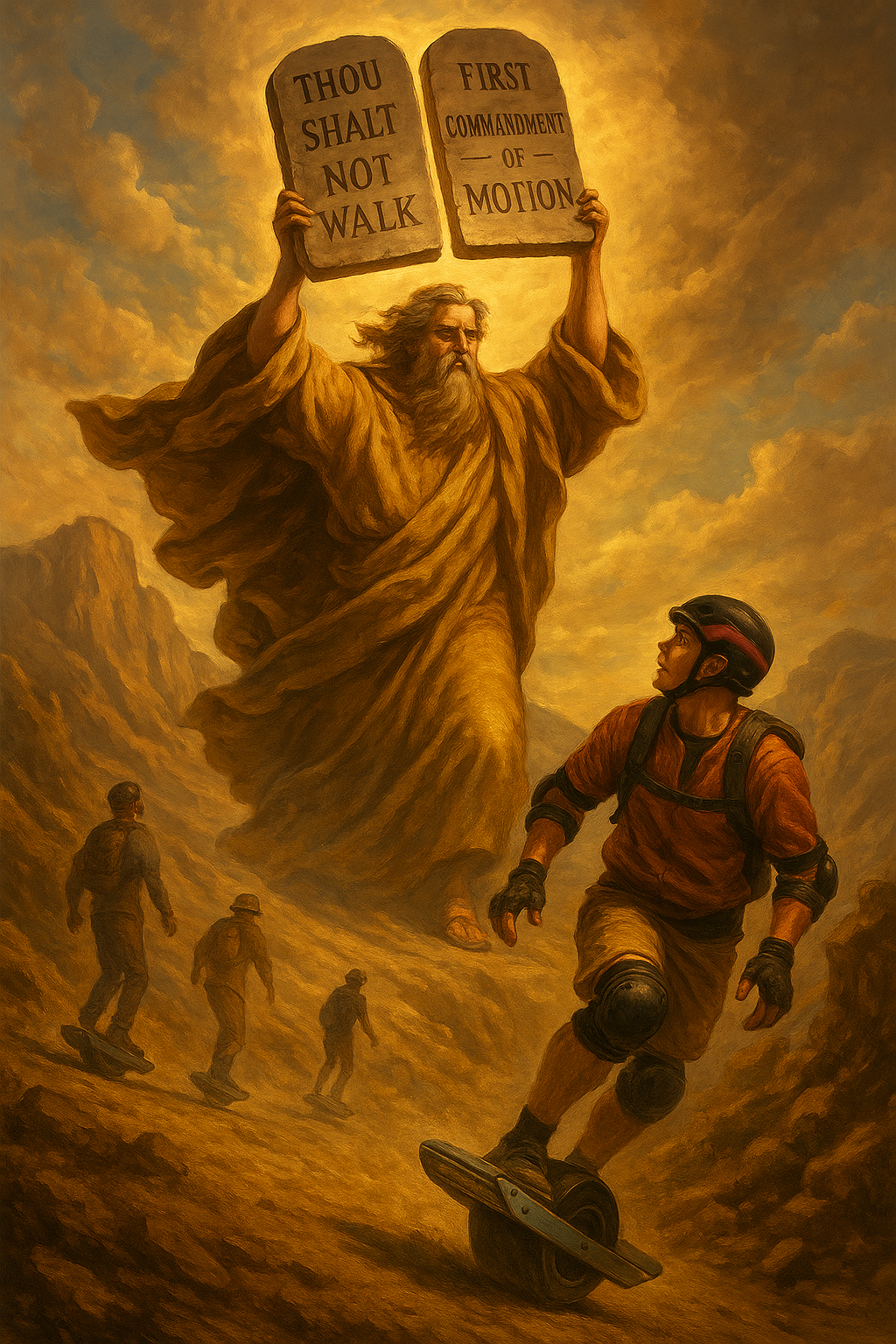
The Great Heat Trial: When Asphalt Becomes the Lake of Fire
Opening Scripture
From The Book of Thermal Warnings, Chapter 6, Verses 1–12
And the sun rose over the parking lot without mercy, and the blacktop became as a griddle before the people.
Yet the rider looked upon the shimmering path and said, “It’s honestly not that bad.”
For he had checked neither the forecast nor the temperature, but had consulted only his enthusiasm.
And the Wheel rested in the garage, cool and blameless, until the rider brought it forth into judgment.
Then did the tire touch the asphalt, and the asphalt answered, “Welcome unto the Lake of Fire.”
Blessed is the wheeliever who seeketh shade before the app seeketh thermal protection.
Blessed is he who carrieth water and drinketh it before becoming philosophical.
Woe unto the rider who saith, “Heat is mostly mental,” for the battery hath no interest in mindset.
Woe unto him who chooseth the blacktop shortcut at noon, for his soles shall learn what his weather app already knew.
Let the hub motor labor, but not unto martyrdom.
Let the rider sweat, but not unto confusion.
For zeal without hydration is merely poor planning in a helmet.
I. When the Pavement Began Preaching Fire
Wheelievers, today we enter The Great Heat Trial, that sacred season when every metal railing becomes cookware and every parking lot looketh like the surface of a hostile planet.
The sky is blue. The sun is high. The group chat is active. Someone says, “Morning ride?” at 10:48 a.m., which is no longer morning in the eyes of the asphalt.
Yet the summer rider is easily deceived.
He steps outside from an air-conditioned home and says, “Feels pretty nice.” Of course it doth. He has been outside for eleven seconds and is standing beneath a porch.
Then he mounteth.
The Wheel begins to roll. The breeze bringeth temporary relief. The rider interprets airflow as evidence that the laws of heat have been suspended for him personally.
But the asphalt remembereth.
The blacktop hath spent all morning receiving the sun like a false prophet receiving donations. It hath stored up wrath beneath the tire. It waiteth with the patience of something that knows every rider must eventually stop at a crosswalk.
And when the wheeliever pauses, the heat riseth.
From below cometh the pavement.
From above cometh the sun.
From within cometh the helmet.
From the pocket cometh the phone, displaying a weather alert that would have been useful forty minutes earlier.
This is the Lake of Fire.
And thou hast ridden into it wearing black knee pads.
II. The False Gospel of “The Wind Will Cool Me”
Let us rebuke a common summer heresy: the wind shall cool me.
The wind is pleasant. The wind is merciful. The wind dryeth sweat fast enough that a rider may temporarily forget he is producing it at the rate of a frightened rotisserie chicken.
But the wind is not hydration.
The rider feels cool while moving and therefore concludes he is cool. This is false doctrine. A moving rider may be overheating with excellent ventilation.
He says, “I’m not even sweating that much.”
Brother, the sweat hath evaporated.
He says, “I feel fine.”
Brother, thou hast just called a stop sign “that red square.”
He says, “Let’s do the hill before heading back.”
Brother, the congregation hath begun discussing whether thou shouldst sit down.
Heat is deceptive because it turneth judgment slowly. First the rider becomes thirsty. Then irritable. Then strangely confident. Then he begins making route suggestions nobody requested.
Blessed are those who drink before thirst becomes prophecy.
Blessed are those who know that a water bottle is not an ornamental cylinder attached to a backpack.
Blessed are those who choose the shaded route, even though the exposed route looketh faster on the map and more heroic in imagination.
For the sun careth nothing for heroism.
It hath been doing this for billions of years.
III. The Parable of Brother Trevor and the Noon Parking Lot
Hear now the parable of Brother Trevor, who was beloved among the wheelievers because he owned a cooling towel, spoke often of electrolyte balance, and remembered none of this when excited.
One Saturday, Trevor proposed a ride.
The forecast spoke plainly: heat advisory, high temperatures, limited shade, and conditions generally hostile to adults wearing protective equipment.
Trevor read this and said, “We’ll go early.”
They did not go early.
One rider was late. Another needed to charge. Trevor himself spent twenty minutes adjusting a camera mount he would later forget to turn on. Thus the “early ride” began at 11:37 a.m., when the sun had already assumed management.
Still Trevor declared, “Once we get moving, it’ll be fine.”
At first, the shaded neighborhood streets offered mercy. The tire hummed. The board carved. The footpad sensor recognized Trevor’s confident stance. He announced that conditions were “actually perfect.”
Then the route entered the Great Retail Parking Expanse.
There were no trees.
There was no shade.
There were only painted lines, shopping carts, distant SUVs, and several acres of blacktop radiating the emotional warmth of an unanswered HR complaint.
The asphalt shimmered.
Trevor continued.
His hub motor labored. His tire softened slightly in the heat. The battery temperature rose. His helmet became a private weather system.
Still he said, “We’re almost through.”
This was not true.
For the parking lot had been designed by men who believed every destination should be visible but spiritually unreachable.
Halfway across, Trevor’s app sent a warning.
He looked at it.
He looked at the far side of the lot.
Then, rather than seeking shade, he said, “I think if we keep moving, airflow will help.”
The elders exchanged glances.
At last they reached a narrow shadow cast by a garden-center awning. Trevor dismounted, sat upon a bag of decorative mulch, and drank water with the intensity of a man who had recently discovered water.
After ten minutes, he said, “That lot was hotter than I expected.”
And an elder replied, “The sun sent thee several written notices.”
Thus learn we: the heat advisory is not a suggestion from nervous people indoors.
IV. The Tire Expandeth, and So Doth the Ego
Now let us speak of PSI in the season of fire.
For tire pressure is not a fixed moral quantity. Heat affecteth the tire. Pavement affecteth the tire. The ride affecteth the tire. Yet some wheelievers check PSI once in spring and thereafter treat it as a lifelong appointment.
They say, “I know how it feels.”
This is the thumb-gauge heresy.
In summer heat, the tire may feel different. The board may handle differently. The carve may sharpen or wander. The rider may notice this and immediately blame firmware, custom shaping, magnetic forces, or a vague decline in manufacturing standards.
Rarely doth he kneel with an actual gauge.
The wise check.
The foolish interpret.
And the extremely foolish post a six-paragraph review of the latest update before measuring the tire.
Remember: the tire is the only part of thy sacred machine touching the Lake of Fire directly. Treat it with respect.
Inspect the tread.
Check the pressure.
Look for damage.
Do not leave the board baking in a sealed car while thou eatest lunch, then retrieve it like a casserole and immediately demand performance.
The Wheel is not a cast-iron skillet.
And the battery is not improved by preheating.
V. Of Hot Cars, Closed Garages, and Other Ovens of Foolishness
I must now address the summer storage sins.
A rider finishes the morning ride and places the board inside the car.
He says, “I’ll take it out when I get home.”
Then he forgetteth.
The sun climbs.
The windows trap the heat.
The car becomes a mobile chapel of thermal regret.
Hours later, the rider opens the door and is struck by air from the furnace district of judgment. The helmet is hot. The pads are hot. The board is hot. The charging cable hath become emotionally unavailable.
And what does the rider do?
He touches the board and says, “Wow.”
Yes, brother. Wow.
Do not store the Wheel in the oven of forgetfulness.
Do not charge it in a sealed garage that feeleth like an attic above a pizza shop.
Do not place a hot board on carpet beneath a pile of gear and assume the saints of ventilation will intervene.
Shade is not weakness.
Airflow is not cowardice.
Temperature awareness is not “babying the board.”
The rider who says, “These things are built to handle it,” is often the same rider who says, “Anybody know what this warning means?” three hours later.
VI. Call and Response at the Edge of the Lake
Leader: What hath the asphalt become?
Wheelievers: THE LAKE OF FIRE.
Leader: What protecteth the rider from zeal?
Wheelievers: SHADE, WATER, AND BASIC FORETHOUGHT.
Leader: What shall we not leave inside the car?
Wheelievers: THE BOARD, THE HELMET, OR A GAS-STATION BURRITO.
Leader: What shall we do when the app warneth of heat?
Wheelievers: STOP ARGUING WITH TEMPERATURE.
Leader: And what shall we say to “one more sunny loop”?
Wheelievers: PERHAPS AFTER THE SUN LOSETH INTEREST.
Amen.
For even the faithful must sometimes wait until evening.
VII. The Weekly Rite of the Shaded Route
Therefore I give unto you this week’s sacred practice: The Rite of the Shaded Route.
Before thy next summer ride, consult the weather.
Not after dressing.
Not after charging.
Not after sending “Who’s in?” to nine people.
Before.
Look upon the temperature, the heat advisory, the sun exposure, and the hour appointed for thy departure. Receive these not as personal criticism, but as publicly available prophecy.
Then choose the route according to wisdom.
Favor trees.
Favor parks.
Favor paths near water, where lawful and sensible.
Avoid vast black parking lots, unshaded industrial roads, and neighborhoods where every tree was removed to make room for decorative stone that reflecteth sunlight directly into the soul.
Carry water.
Actually drink it.
Do not wait until the bottle hath become hot enough to brew tea and thy lips have begun making independent decisions.
At the halfway point, stop in shade and perform the Three Thermal Questions:
“How do I feel?”
“How doth the board feel?”
“Am I continuing because the ride is good, or because I announced a mileage goal?”
If the final answer convicteth thee, shorten the route.
Return before depletion.
Cool the board.
Cool thyself.
And tell no one that cutting the ride short was “a strategic deload.” Thou were hot. This is allowed.
VIII. The Mirage of Summer Bravado
Heat produceth mirages.
In the desert, a man sees water where none exists.
In rider culture, a man sees competence where hydration hath departed.
The overheated rider becomes strangely brave.
He proposes hills.
He ignores chirps.
He dismounts clumsily and says the footpad felt weird.
He begins explaining battery chemistry to people who are merely trying to get him beneath a tree.
This is summer bravado.
It is not courage.
It is the mind running in low-power mode while the mouth remaineth fully operational.
Beware the rider who becomes more confident as conditions worsen.
Beware thyself when irritation rises, coordination fades, or the route begins feeling confusing though thou hast ridden it many times.
The body sendeth pushback too.
Honor it.
The brain may not display a clean warning icon, but when thou beginnest calling a water fountain “that silver drinking post,” the message hath arrived.
IX. The Air-Conditioned Temptation
There cometh a moment in every Great Heat Trial when the rider passes an open café, store, library, lobby, or other blessed structure from which cool air escapeth.
The air touches his face.
The rider sloweth.
He sees others inside sitting beneath vents, holding iced beverages, living without helmets.
And he is tempted.
Some call this weakness.
I call it providence.
There is no shame in entering the air conditioning.
Bring the board carefully.
Do not strike the pastry case.
Set it where no one will trip.
Order water, something cold, or a snack containing enough salt to restore thy personality.
Sit.
Let the sweat cease.
Let the board rest.
Let the employee behind the counter wonder why a grown adult dressed like a futuristic crossing guard is breathing so heavily near the muffins.
This is humility.
A pilgrimage may include refuge.
Even prophets entered caves.
Thou mayest enter the frozen-yogurt shop.
X. Thou Shalt Not Make Suffering Content
Now I must warn the influencers, aspirants, and men who become cinematic whenever the temperature exceedeth ninety.
Do not make heat suffering into proof.
Do not post “embracing the grind” while thy board is issuing warnings and thy water bottle remaineth full.
Do not film thyself crossing exposed asphalt at noon because the heat waves look visually impressive.
Do not call preventable overheating “an epic summer challenge.”
The road needeth not become an ordeal to validate the ride.
An uneventful shaded loop at sunset is holier than a noon mission that endeth with confusion beside a vending machine.
There is no medal for hottest pavement endured.
No angel recordeth “most sweat beneath wrist guards.”
No follower truly needeth a thermal testimony from a strip-mall parking lot.
Ride for joy.
Ride for peace.
Ride when the conditions permit the Wheel and body to cooperate without litigation.
XI. The Lake of Fire Within
Finally, wheelievers, we must speak beyond the blacktop.
There is an asphalt within the soul.
It absorbeth every obligation, every Slack ping, every frustration, every family demand, every unfinished task, every comment from a stranger who says, “Those things are illegal here, right?”
The heat collecteth.
Then one small inconvenience arrives—a sensor hesitation, a dropped glove, a route closure—and suddenly the spirit radiateth judgment like a parking lot at noon.
This too requireth cooling.
Do not carry every heat into the ride.
Breathe.
Find shade.
Drink water.
Let the tire hum without forcing it to solve thy entire life.
The Wheel may restore balance, but it is not responsible for processing every resentment thou brought from the office.
Cool thy zeal.
Cool thy anger.
Cool thy need to turn every ride into evidence that thou art doing well.
Sometimes the miracle is simply returning home less overheated than when thou left.
Closing Words
From The Gospel of Grip Tape, Chapter 38, Verses 5–14
Go forth with caution beneath the high sun.
Let thy route seek shade, thy bottle contain water, and thy judgment remain cooler than the pavement.
Despise not the warning of the app, nor the weariness of the body.
Leave not the Wheel inside the chariot of glass, lest it bake beneath forgotten errands.
Honor the tire that toucheth the fire and the hub motor that laboureth unseen.
Let not summer bravado become thermal testimony.
Blessed is the rider who stoppeth before confusion.
Blessed is the wheeliever who chooseth evening over ego.
For the asphalt may become the Lake of Fire, but thou art not commanded to ride through hell at noon.
And may thy battery stay cool, thy water stay plentiful, and thy summer rides end beneath merciful shade.
Did this sermon spare thee from walking?
Toss $5 into the offering plate to keep the sermons flowing, the wheel turning, and the Prophet only moderately overconfident.
Bless the Wheel — $5No pressure. No indulgences sold. Just sacred nonsense, lovingly maintained.
Continue the Pilgrimage
The Wheel has more wisdom to reveal. Read another sermon before returning to the cursed world of walking.