Solstice of the Single Wheel: Father, Son, and Holy Hub Motor
Opening Scripture
From The Book of Bearings, Chapter 27, Verses 1–12
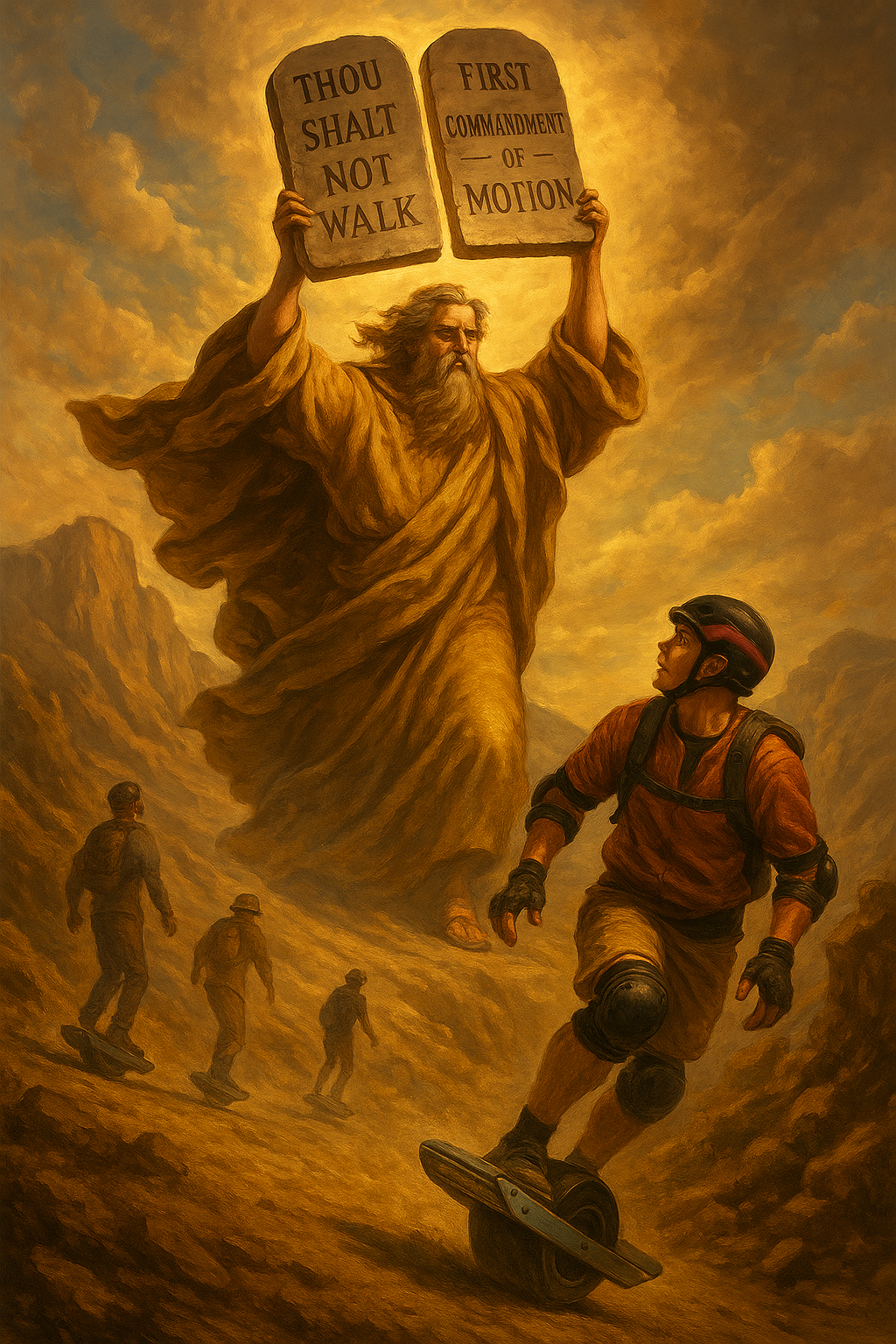
And on the longest day, when the sun tarried in the sky like a rider refusing to end the group ride, the wheelievers gathered beneath the golden heat.
And they beheld the Wheel, singular and sufficient, turning upon the earth.
And one among them said, “Behold, it hath only one tire.”
And another answered, “Yea, and yet it containeth multitudes.”
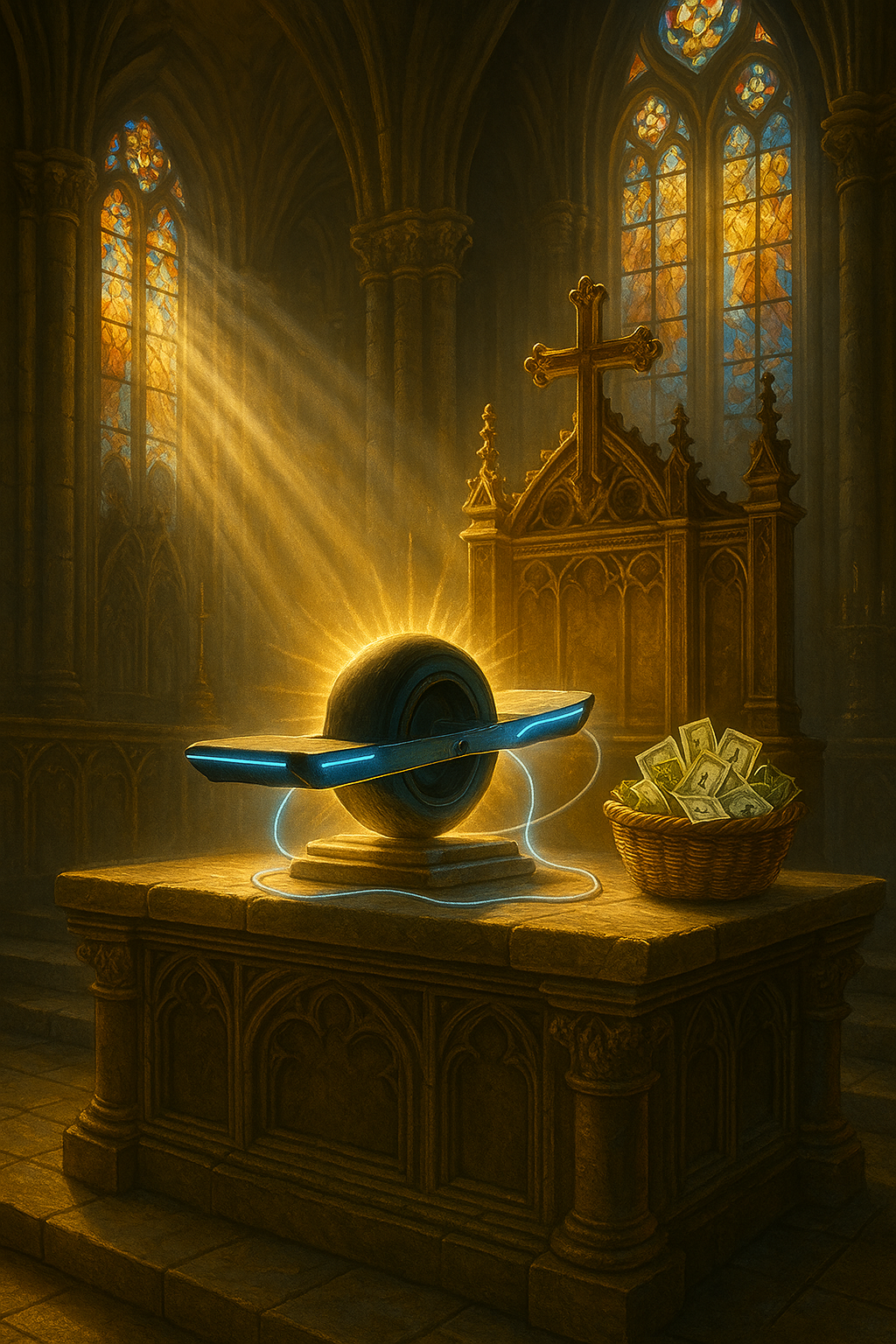
For there is the Father, who provideth the board.
And there is the Son, who rideth with questionable confidence.
And there is the Holy Hub Motor, unseen within the tire, humming with torque and mysterious judgment.
Blessed is the rider who honoreth the single wheel and divideth not his trust among scooters.
Woe unto him who worshipeth many tiny wheels, for his path shall be rattly and his dignity fragmented.
For the hub motor speaketh not loudly, but by acceleration, resistance, pushback, and the faint warmth of effort.
Let the sun stand high, let the tire roll true, and let no man confuse balance with stability.
For the single Wheel is enough, and the hub motor knoweth the hill before thou dost.
I. The Longest Day and the Shortest Patience
Wheelievers, today we celebrate the Solstice of the Single Wheel, that sacred turning point when the sun stretches its golden arms across the land and says, “I shall be here longer than necessary.”
This is a day of light. A day of heat. A day when riders who complained all winter about darkness suddenly complain that the sun is “a little much.” Such is man: impossible to satisfy, yet eager to check the app.
On the solstice, the road seemeth endless. The evening ride begins at 6 p.m., then somehow continues until 9:12 because nobody wants to be the first to say, “I should probably go home.” The battery droppeth. The headlamp remaineth unused but emotionally present. Range anxiety begins as a whisper and ends as a theological debate near a water fountain.
And yet, amid this long daylight, the Wheel revealeth a short truth:
One is enough.
One tire. One hub. One balancing act between glory and urgent care. One rider standing above one spinning mystery, believing himself in control while the Holy Hub Motor quietly handles the math.
The world says more is better. Two wheels. Four wheels. All-wheel drive. Extra motors. Backup motors. A scooter with enough tiny components to require a family office.
But the Wheel says, “No. Let there be one.”
And somehow, against the advice of grandmothers, neighbors, and people who use the phrase “seems unsafe” as a spiritual gift, it is sufficient.
II. Father, Son, and Holy Hub Motor
Now let us consider the trinity appointed unto the ride.
First, the Father: the Maker, the Provider, the mysterious source of board, charger, tire, firmware, app updates, replacement parts, and warning emails that everyone reads halfway before getting distracted.
The Father giveth the Wheel.
Second, the Son: the rider, beloved yet impulsive, gifted yet ridiculous, capable of both courage and saying “watch this” near a curb. The Son mounteth the footpad. The Son bendeth the knees, or forgetteth to. The Son receiveth pushback and must decide whether to repent or begin negotiations with physics.
The Son rideth the Wheel.
Third, the Holy Hub Motor: unseen within the tire, humming beneath all things, converting stored charge into forward testimony. It is hidden, yet active. Quiet, yet powerful. Buried in rubber and mystery, surrounded by PSI, torque, bearings, and the faint possibility of overheating if the Son insists on climbing a hill at low battery while full of confidence and barbecue.
The Hub Motor sustaineth the Wheel.
And here is the sacred lesson: the rider often receives the attention, but the hub motor doeth the ministry.
Men post their top speed. Men post their carve. Men post screenshots, route maps, and slow-motion clips in which the lighting is generous and the mistakes have been edited out. But beneath the performance, the Holy Hub Motor labors unseen, whispering through torque, “Brother, I am doing more for this ride than your personality.”
Blessed are those who remember the hidden worker.
Blessed are those who say, “Thank you, motor,” before saying, “I’m getting pretty good.”
Blessed are those who do not mistake humming support for personal greatness.
III. The False Gospel of More Wheels
Now, wheelievers, I must address the many-wheeled nations.
They come unto us saying, “Why one wheel?” They speak with concern. They gesture toward bicycles, scooters, skateboards, e-bikes, and vehicles with cup holders. They say, “Wouldn’t two wheels be more stable?”
Stable, yes.
Holy, no.
For stability is not the same as balance. Stability is what people seek when they do not wish to participate. Balance requireth presence. Balance requireth humility. Balance requireth that thy body, board, sensor, gyro, stance, and inner life hold a committee meeting every second.
Two wheels say, “Relax, we’ve got this.”
Four wheels say, “Sit down and bring snacks.”
But one wheel says, “Become worthy in real time.”
That is the difference.
The single Wheel is not efficient because it is easy. It is efficient because it refuseth unnecessary compromise. It cuts away the clutter. It asketh the rider to meet it directly over the axle, neither too proud nor too timid, neither charging ahead nor leaning back like a man reconsidering his life choices.
This is why scooters do not understand us. They are busy multiplying parts while we are entering into covenant with one tire and a hub motor that knows exactly how foolish we are.
Woe unto the man who worshipeth extra wheels because he feareth correction.
Woe unto the rider who mocks the single Wheel and then trips over his scooter charging cable in the garage.
For the many-wheeled may arrive upright, but they shall never know the sacred terror of a perfectly timed mount.
IV. The Parable of Brother Landon and the Hill of Solstice Pride
Hear now the parable of Brother Landon, who was beloved among the wheelievers because he spoke often of torque, owned a digital tire gauge, and believed sunlight made him more capable.
On the day of the solstice, Landon looked upon the golden evening and said, “There is time for one more loop.”
There was not time for one more loop. There was only daylight, which is not the same as wisdom.
But Landon saw the sun still high and mistook visibility for permission. His battery was at 23%, which he called “plenty” because men under the influence of good weather become terrible accountants. His PSI was acceptable. His stance was decent. His confidence was unregulated.
So he rode.
And the Wheel carried him faithfully through the neighborhood, across the greenway, past the park, and toward the Hill of Unnecessary Proof. It was not the steepest hill. It was not the longest hill. But it was perfectly placed at the end of a ride, where low battery and high ego like to meet for coffee.
Landon approached the hill and said, “The hub motor’s got this.”
Now the Holy Hub Motor did have much.
It had torque. It had purpose. It had a long history of cleaning up Landon’s questionable decisions. But it did not have infinite power, nor did it enjoy being volunteered for drama at 23% battery under late-day heat.
Halfway up the hill, the Wheel hummed deeper.
Landon leaned.
The motor worked.
Battery sag entered quietly.
Pushback lifted its hand.
Still Landon said, “Come on, come on,” as though the motor were a youth athlete and he a father making everyone uncomfortable.
Then the board slowed.
Not violently. Not cruelly. Just enough to say, “My child, the sermon is now about thee.”
Landon stepped off and walked the last twenty yards uphill in full gear, carrying the board beside him while pretending this had been part of his training plan.
A teenager on a scooter passed him going downhill and said nothing, which somehow made it worse.
When Landon returned to the congregation, he said, “Honestly, I think the heat affected performance.”
And the elders replied, “Nay, brother. The heat revealed performance.”
Thus learn we: the Holy Hub Motor is mighty, but it is not a magic donkey for thy solstice ego.
V. The Sacred Heat Beneath the Fender
Let us now speak of heat.
On solstice days, heat is everywhere. On the pavement. In the garage. In the battery. In the motor. In the rider’s helmet. In the group chat, where someone always suggests a route with “only one big climb” as if that phrase has ever preceded peace.
Heat is not evil. Heat is information.
The wise rider observes the day and adjusts. He brings water. He plans shade. He does not begin a heroic hill climb at the exact hour when the sidewalk is radiating stored judgment. He understands that machines, like people, do not become wiser when overheated.
The foolish rider says, “I’ll be fine,” which is among the great curses of summer.
The hub motor labors inside the tire, hidden from sight, turning charge into motion and motion into warmth. When thou demandest too much—too steep, too fast, too heavy, too low battery, too much bravado—it begins to preach through temperature.
And the board may warn thee.
It may push back.
It may slow.
It may chirp.
It may tell the app things thou shouldst have known before leaving.
Do not despise this. The Holy Hub Motor is not being dramatic. It is protecting the system from thy plotline.
Leader: Who provideth the board?
Wheelievers: THE FATHER.
Leader: Who rideth with questionable confidence?
Wheelievers: THE SON.
Leader: And who hums beneath the tire?
Wheelievers: THE HOLY HUB MOTOR.
Leader: What shall we not ask of it?
Wheelievers: ONE MORE HILL ON LOW BATTERY.
Amen. May this wisdom reach the calves before the climb.
VI. The Weekly Rite of the Single Wheel
Therefore I give unto you this week’s sacred practice: The Rite of the Single Wheel.
Before thy next ride, stand beside the board and behold its simplicity. One tire. Two footpads. One hub motor. One battery whose percentage is not symbolic. One charger you hopefully remembered to use. One rider who is almost certainly overestimating something.
Then place thy hand near—but not upon—the tire, for some of you need instructions that specific.
Say aloud:
“I shall not confuse sunlight with safety.
I shall not confuse torque with permission.
I shall not confuse one more loop with destiny.”
Next, check thy PSI. Check thy battery. Check the route. Check the weather. Check whether thy desire to ride is actually a desire to prove something to an invisible audience.
Mount with humility. Let the footpad sensor detect thee. Let the self-leveling settle beneath thee. Begin not with a flourish, but with a smooth and boring start, for boring starts have saved more dignity than courage ever did.
On the ride, honor the hub motor by not making every incline a referendum on thy masculinity, fitness, youth, technical knowledge, or recent internet research.
If the board warms, slow. If pushback cometh, heed. If range anxiety riseth, listen. If thy friend says, “We can totally make it,” ask whether this friend has historically been correct about anything involving battery percentages.
And when thou returnest home, let the Wheel cool. Plug it in properly. Coil the cable with intention. Give thanks for the motor that carried thee and the restraint that kept thee from becoming the parable.
VII. A Warning Against Solstice Over-Glory
Now I must warn the summer-bold among you.
Long daylight is intoxicating. It maketh adults act like school is out. It whispereth, “Ride farther.” It suggesteth, “You have time.” It seduceth riders into second loops, late climbs, scenic detours, and the tragic phrase, “Let’s just check out that trailhead.”
But the sun staying up does not mean thy judgment did.
The solstice is not a permission slip. It is a mirror. It showeth how long a man will keep going when nobody turns the lights off.
And some of you need the lights turned off.
You ride until the battery droops. You ride until the water bottle is empty. You ride until the group chat goes quiet because everyone is silently calculating how far the garage is. You ride until the Holy Hub Motor begins humming in a tone that, if translated, would say, “We have discussed this.”
Do not make the longest day into the shortest lesson.
Let the solstice teach balance, not excess. Let the single Wheel remind thee that enough is holy. Let the hub motor remain a helper and not a witness for the prosecution.
For the rider who stops while still strong is wiser than the rider who continues until the board files a thermal complaint.
VIII. The Mystery of the Center
At the heart of the Wheel is the hub.
At the heart of the ride is balance.
At the heart of balance is the center.
This is why the single Wheel is more than transport. It is a daily rebuke to scattered living. It says, “Come back to the center.” Not tomorrow. Not after the hill. Not after one more loop. Now.
The centered rider hears the board before it shouts. He feels the pushback before it becomes drama. He notices heat, sag, chirp, wobble, and fatigue. He does not demand miracles from the motor when ordinary prudence would do.
The centered rider is not boring. He is free.
Free from performing. Free from explaining. Free from turning every ride into a courtroom where firmware must defend itself. Free from the tyranny of proving he could have made that hill if conditions were slightly different and no one had been watching.
The Wheel is single because the lesson is single:
Be present.
Over the axle.
In the body.
With the board.
Under the sun.
Above thy ego.
Closing Words
From The Gospel of Grip Tape, Chapter 28, Verses 13–20
Go forth beneath the long sun with reverence and shade when available.
Honor the Father who provideth, the Son who rideth, and the Holy Hub Motor that hums unseen beneath the tire.
Let thy battery be sufficient, thy PSI honest, and thy route chosen with sober joy.
Ask not the motor to carry what humility should have refused.
Despise not the single Wheel, for in its oneness it revealeth the center.
Blessed is the wheeliever who stops before glory curdles into consequence.
Blessed is the rider who cools the board, charges the battery, and lets the day end without drama.
And may thy solstice ride be long enough for joy, short enough for wisdom, and centered enough to bring thee home.
Did this sermon spare thee from walking?
Toss $5 into the offering plate to keep the sermons flowing, the wheel turning, and the Prophet only moderately overconfident.
Bless the Wheel — $5No pressure. No indulgences sold. Just sacred nonsense, lovingly maintained.
Continue the Pilgrimage
The Wheel has more wisdom to reveal. Read another sermon before returning to the cursed world of walking.